







By Galaxy IT
Last updated: Oct. 31, 2026
Hourly IT support pays a provider for time, so a problem that returns is more billable work rather than a failure. A flat-rate plan with unlimited remote help desk support for covered issues reverses that incentive: The provider does better by preventing problems and resolving them the first time. That principle guides Galaxy IT’s managed IT services for Utah businesses.
What did working at a big MSP teach our founder about hourly billing?
Our founder once worked at a large managed service provider (MSP). He can speak only to how things worked there at the time. In his experience, technicians’ pay and bonuses were tied to billable hours, not to resolving a problem on the first attempt. When a customer called back with the same issue, the callback counted as more billable time. In his view, that arrangement meant a problem that came back could help a technician’s numbers more than a first-time fix did.
Technicians also worked under a billable-hour target set high enough to leave little room for anything else.
Consider a target of 90% billable hours in a 40-hour week. That’s 36 hours of billed client work, leaving four hours for everything else a conscientious technician ought to do: documenting a fix so the next person doesn’t start from zero, learning a new security tool, tracing why the same alert keeps firing. None of that work counts toward the number.
Here’s a hypothetical at any shop that’s paid by the hour. The front desk’s shared mailbox stops syncing. The technician can invest extra time in finding the root cause, or apply the quick fix, close the ticket and log the time. If the problem returns next week, that’s another billable ticket. No one has to say “do a bad job.” The billing model says it for them.
Our founder is careful not to overstate this. It may not be fair to say the whole MSP industry works this way, and plenty of good providers don’t. But in his view, at some of the larger companies, including some backed by private equity (PE), the business runs on billable hours rather than on fixing the customer’s issue. In his experience, technicians at those shops can get pushed to work long hours, bill for every single thing they do for a customer and prove they’re profitable enough for their employer to keep them on board.
That job gave our founder a precise picture of what he didn’t want Galaxy IT to be.
Why doesn’t Galaxy IT nickel-and-dime its clients?
At Galaxy IT, we don’t nickel-and-dime you. What we care about is your success, our partnership and your trust, and none of them can be billed by the hour. In our entire history, we have never enforced billable-hour targets for anyone at Galaxy IT.
Every Galaxy managed IT plan uses flat monthly pricing for everything in your plan’s scope and includes unlimited remote help desk support for covered issues. When a covered issue comes back, fixing it remotely is on us, not you. That arrangement keeps our incentive aligned with yours: We want every problem fixed right the first time and kept from coming back. Every plan also includes layered cybersecurity, because security is the job, not an add-on line item.
What has running Galaxy IT taught our founder about service?
Galaxy IT runs on passion, dedication and a great deal of hard work, all directed toward one goal: giving our clients the absolute best service. The lesson our founder keeps returning to is that customers stay only when they’re taken care of. He describes it this way:
Building a business is not for the faint of heart. Every stage teaches you something, and those lessons are worthless unless you act on them. You have to adapt quickly, and above all, you have to make certain your clients are well cared for and genuinely satisfied. Growth alone proves nothing. Having customers doesn’t mean they’re happy, and it certainly doesn’t mean they’ll stay.
The same conviction shapes how our founder approaches hiring:
I hire only the best of the best, people committed to delivering the finest service possible. Anyone unwilling to meet that standard isn’t the right fit for Galaxy.
We don’t hire someone from a big-box electronics store simply because they can install antivirus. We hold every technician to a higher standard than that, because good enough falls short.
His offer to every business owner who’s tired of IT problems is equally direct:
If you want premium service and you’re tired of losing entire days to downtime, come to us. We’ll take care of you, and I’ll make sure the best people are doing the work.
Speed matters, but not only in how fast we answer. A fast response is welcome, but in our founder’s words, a fast resolution is “more critical than anything else.” Reaching someone quickly offers little comfort if your problem is still there at the end of the day.
Galaxy IT doesn’t need to be the biggest IT company around. As our founder sees it, the goal is simpler and more demanding than that:
Size has never been the measure. What matters is delivering the best service available, every time.
He wants Galaxy IT to be the company a client misses after switching away, the one that leaves them thinking, “Boy, I miss Galaxy.”
The feedback our founder values most comes from clients who tell him how competent our team is, how much they enjoy our service and how much they enjoy our people. In his words, “Nothing is more rewarding.”
The greatest compliment I’ve ever received came from a client who told me, “I’ll renew with you, and I’ll commit to five years.”
Partnership also means putting our own money in when it counts. When a situation arose with one client, our founder offered that Galaxy would cover the full cost in that case, to show the client that we were there to make the partnership work. He was unwilling to make the client foot the bill.
When it matters, we invest our own money to show clients that we’re genuinely their partner.
That is the whole plan from here. In our founder’s words:
My focus is simple: keep raising the bar, and keep earning the loyalty of the clients we already have.
How do hourly, block-hour and flat-rate IT support work?
Most IT providers bill in one of three ways: by the hour, by a prepaid block of hours or by a flat monthly fee for a defined scope. The model matters more than the rate, because it determines what the provider earns more from.
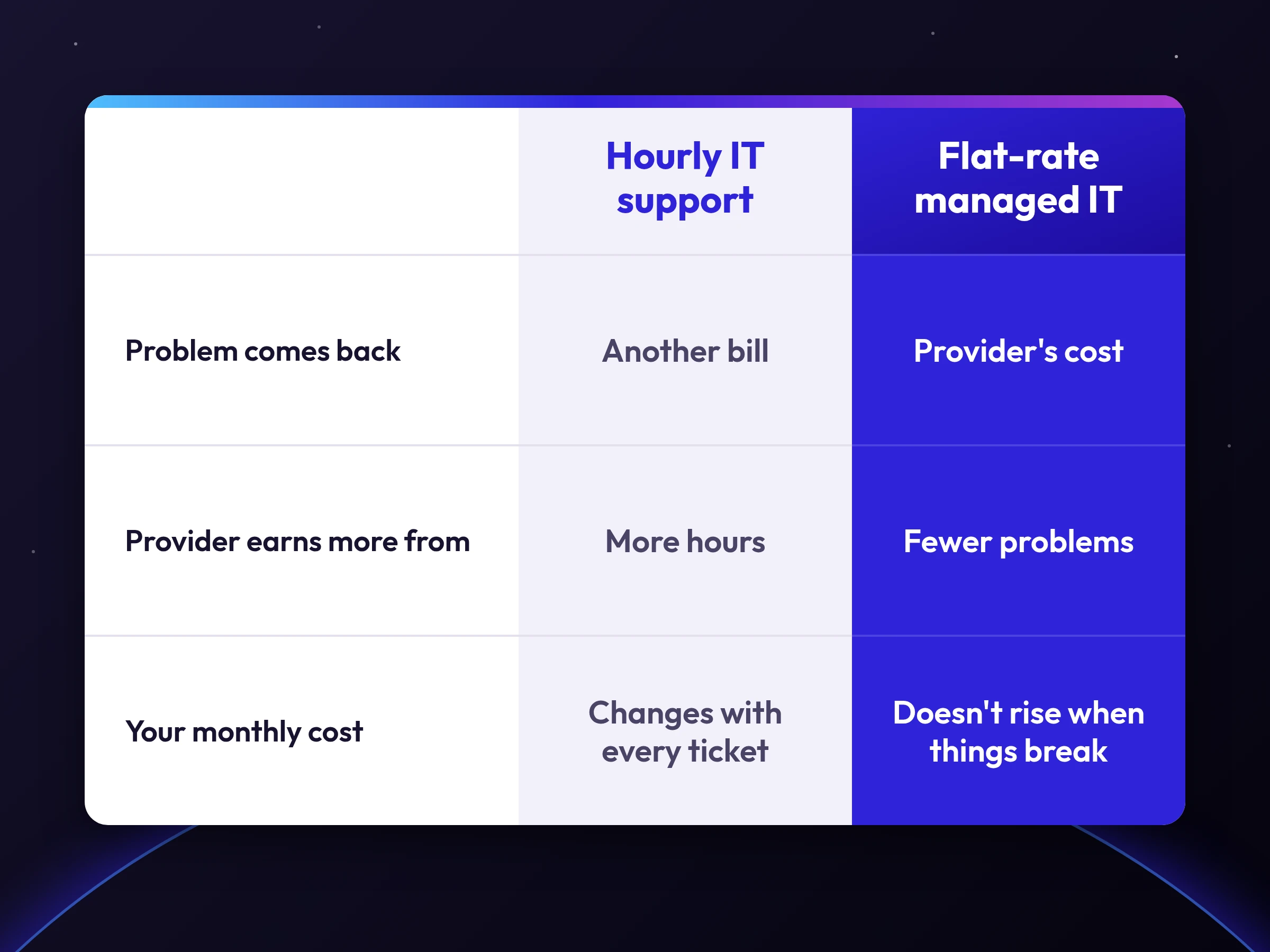
| Billing model | How you pay | What the provider earns more from |
|---|---|---|
| Hourly (time and materials, often called break-fix) | A rate for the time worked on each issue, plus parts | More hours: more tickets, longer fixes, repeat visits |
| Block hours | A prepaid bundle of hours; under some contracts, unused hours expire and extra hours are billed hourly | Hours you buy, plus overage when you run past the block |
| Flat-rate managed IT (often called all-you-can-eat or unlimited support) | A fixed monthly fee, usually per user or per device, for everything in the agreed scope | Fewer problems and faster fixes |
Hourly support. Kaseya, which makes billing software for MSPs, says hourly time-and-materials pricing “is typically used in the ‘break-fix’ model” and tells providers to open a new ticket for every issue “even if it only takes 10 minutes” so they capture all billable time. Under that logic, every ticket becomes a line item. For a simpler side-by-side, see our post on break-fix vs. managed IT.
Block hours. A block-hour contract sells you a set amount of support time each month. In the version described in Syncro’s guide to MSP billing models, unused hours expire at the end of the month, and hours over the block are billed at an hourly rate. It resembles a plan, but in substance you’re still buying time.
Flat-rate managed IT. In an all-you-can-eat agreement, MSP Outpost explains, the client pays one fixed fee per user or per device and “every ticket inside the agreed scope is covered, whether they open two a month or twenty.”
Why does hourly billing reward problems that come back?
Hourly billing rewards repeat problems because the provider’s revenue rises with hours worked, not with problems solved. A permanent fix ends the billing; a partial fix can start it again. Nothing in that pay structure pushes the provider toward the permanent fix.
This isn’t only our founder’s opinion. Service Leadership, a firm that benchmarks IT service providers, described the hourly side of the business in a 2019 benchmark chart as “ad hoc time & material services, staff augmentation, block time, and other billable hour services where efficiency is not directly rewarded.” For flat-fee managed services, the same chart said “efficiency yields higher” gross margin.
Contrast that with how help desk benchmarkers keep score: They give no credit for a callback. In his column on first contact resolution, MetricNet’s Jeff Rumburg writes that calls “that require a customer callback, or are escalated to another source of support, do not qualify,” and he calls first contact resolution “the most important driver” of customer satisfaction. SQM Group, which benchmarks more than 500 North American call centers, found that every 1% improvement in first call resolution brings a 1% improvement in customer satisfaction.
In help desk scoring, the second call is a miss. Under hourly billing, it’s a second invoice.
What do billable-hour targets do to technicians?
Billable-hour targets determine how much time a technician has to do the job right. Set the target too high, and the first things cut are root-cause work, documentation and training, the very habits that keep your problems from coming back.
A 90% target would sit well above the benchmarks published by the industry’s own advisers:
- Sea-Level Consulting figures published by Auvik use 76% as the yearly billable benchmark. Because vacation, sick days, holidays and training are 0% billable, a tech has to be nearly 83% billable on the days they work just to average 76% for the year.
- Bennett Financials, a firm that provides part-time chief financial officers to service businesses, puts average performers at 55% to 60%, good operators at 65% to 70% and top performers at 75% to 80%. Above 85%, it says, “you’re looking at technicians about to quit.”
For you, burned-out technicians show up as rushed fixes, high turnover and tickets passed from one technician to the next. The technician who finally learned how your network fits together leaves, and the next one starts from scratch on your time.
What changes when private equity buys an MSP?
Private equity firms generally buy companies to grow their earnings and sell them later, so a PE-backed MSP is often being built for its next sale. That doesn’t make every PE-backed provider a poor choice. It does change where the pressure falls.
Deal activity has been steady. Investment bank Drake Star, which tracks MSP deals in the United States and Europe, counted 466 MSP investment transactions in 2025, up about 20% from 389 in 2024, then 121 in the first quarter of 2026 and 117 in the second. Those counts include every kind of buyer, and Drake Star says other IT companies do most of the consolidating, with PE and other financial investors also active. Greenwich Capital Group wrote that PE investment in the MSP space “remained strong” in the first half of 2025, drawn in part by the sector’s “predictable revenue streams.”
When a company is being built for its next sale, every billable hour and add-on fee can raise the price a buyer pays. That is a sound reason to ask any provider, PE-backed or not, how it bills and how it pays its technicians.
How does a flat-rate unlimited support agreement change the incentive?
A flat-rate agreement with unlimited remote help desk support for covered issues pays the provider the same amount each month, regardless of how many tickets you open. A problem that comes back now costs the provider time it can’t bill, so the provider does best by fixing it once and preventing the next one.
MSP Outpost puts it plainly: The model gives the MSP “an incentive to prevent problems instead of billing for them,” and gives the client “a budget line that does not move when something breaks.” For a flat-rate provider, the least expensive ticket is the one that never gets opened, which is why good flat-rate providers devote their time to monitoring, patching and permanent fixes.
Flat-rate billing isn’t inherently honest, though. A provider can underprice a plan and then slow-walk tickets, or carve so much out of scope that routine work turns into project fees. That is nickel-and-diming in another form. Read the exclusions before you sign, and ask how the provider tracks repeat problems.
Which questions show how an IT provider really makes money?
The quickest way to understand a provider’s incentives is to ask how it bills and how it pays its technicians. These five questions cover both, and a good provider answers each one without hesitation:
- What happens on the bill when the same problem comes back?
- Are your technicians measured or bonused on billable hours?
- What does “unlimited” cover, and what gets billed as a project?
- Do unused block hours roll over, or do they expire?
- What’s your minimum billing increment for a ticket?
If the answers give you pause, you don’t have to stay. A provider that profits from your problems has little reason to end them.
Who does Galaxy IT choose to partner with?
We’re selective about the businesses we partner with. We take on only clients we want to work with, and they also have to fit how we work. Some would call that an exclusive partnership. Our founder regards it as the only way managed IT works: a partnership built on trust and integrity. Before we propose anything, we sit down with the people who run your business, learn how it operates and build the package around it.
Declining the wrong fit is what allows us to do the work properly for the clients we have. If you’d like to understand what makes an IT partnership work from your side of the table, read our six ways to develop a successful partnership with your IT provider.
Several billion-dollar private equity firms, both local and international, have approached us about buying Galaxy IT. We’ve said no.
Galaxy IT is a Utah-based managed IT and cybersecurity company serving businesses across all of Utah, including the Wasatch Front.
If you’d like a candid answer on whether a flat-rate partnership suits your business, begin with a free IT assessment. The first step is a direct call with our founder.
Frequently asked questions
Is hourly IT support ever the right choice?
Hourly IT support can make sense for a very small business that runs simple, cloud-based systems and needs help only a few times a year. The trade-off is that nobody is monitoring, patching or testing backups between calls, so problems surface only after something breaks. Once IT issues cost your team real working time, a flat-rate plan usually fits better.
What does “unlimited remote support” usually cover?
Unlimited remote support usually covers help desk tickets for the users and devices on the agreement, plus monitoring, patching and routine maintenance, regardless of how many tickets you open. Hardware, licenses and projects such as office moves or migrations are commonly billed separately. Ask any provider for a written list of what’s in scope and what isn’t.
What are block hours in IT support?
Block hours are a prepaid bundle of support time, bought monthly or up front, and each ticket draws down the balance. Under some block-hour contracts, unused hours expire at the end of the month and extra hours are billed hourly. Because blocks still pay the provider for time, the incentive to finish quickly remains weak.
Can flat-rate IT providers have bad incentives too?
Yes, flat-rate providers can. A flat-rate provider that underprices its plan may be tempted to slow down tickets or shift routine work into billable projects. Protect yourself by asking how the provider measures first-time fixes and repeat tickets, and what the agreement excludes. A good flat-rate partner can show you that data and explain every exclusion in plain language.
