





Last updated: Nov. 23, 2026
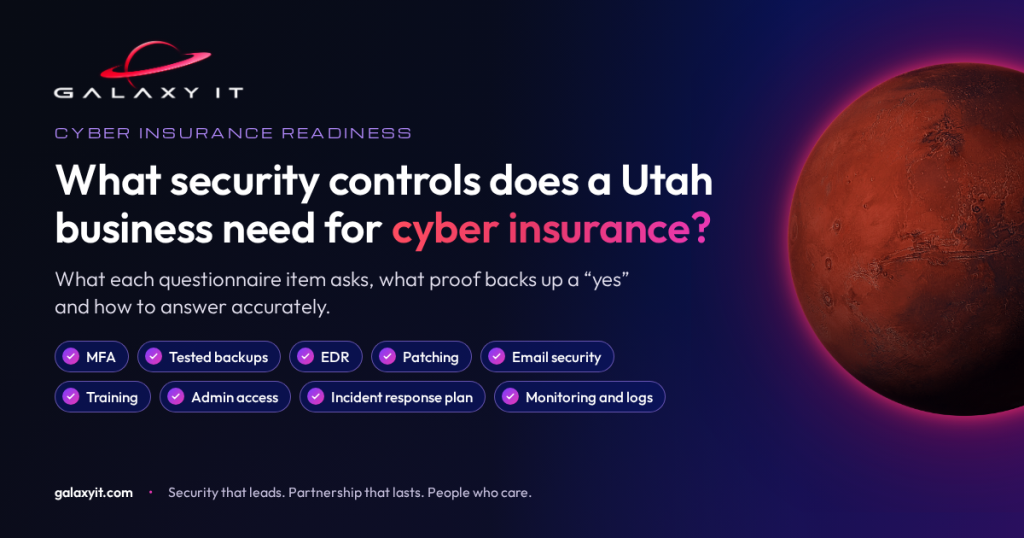
Before you apply for cyber insurance, have multi-factor authentication (MFA), tested backups, endpoint detection and response, steady patching, security awareness training and a written incident response plan in place. Those are the areas insurers typically ask about. Galaxy IT, a Utah-based managed cybersecurity company, helps businesses put them in place and answer the questionnaire accurately.
Your agent or broker sends the application, usually a questionnaire, and its questions often call for a simple yes or no. Our clients bring those questionnaires to us, and when a question stumps them, we help them answer it. The same topics come up again and again, so this guide walks through what each question asks, what proof backs up a “yes” and how to answer accurately.
Is there one standard cyber insurance checklist?
No. Each insurer writes its own application. The Environmental Protection Agency’s 2024 cyber insurance guide for water and wastewater utilities says that underwriting questionnaires “are not harmonized across the industry” but that insurers typically ask about:
- MFA
- Security awareness training and testing
- Data backups
- Endpoint detection and response
- Vulnerability management
- Incident response and business continuity plans
- Third-party vendor management
A smaller business may see a short form. The U.S. Government Accountability Office found in a 2022 report that there is “no standard cybersecurity risk assessment across providers.” The same report cites a British think tank’s finding that smaller businesses may answer “a short questionnaire of as few as four questions,” while larger companies can face interviews and site visits.
New York’s insurance regulator lists similar topics in its cyber insurance risk framework for insurers, from access controls and encryption to endpoint monitoring and incident response planning. The framework is a New York circular letter, not a Utah rule, but it’s a useful public list of what underwriters look at.
Utah law requires any person who conducts business in the state and maintains personal information to “implement and maintain reasonable procedures” to prevent its unlawful use or disclosure, and to destroy, or arrange for the destruction of, records containing personal information that will not be retained.
Treat your own application as the final word. The National Association of Insurance Commissioners (NAIC) advises business owners to discuss with their insurance agent which policy fits their company.
What does each security control question ask, and what proves a yes?
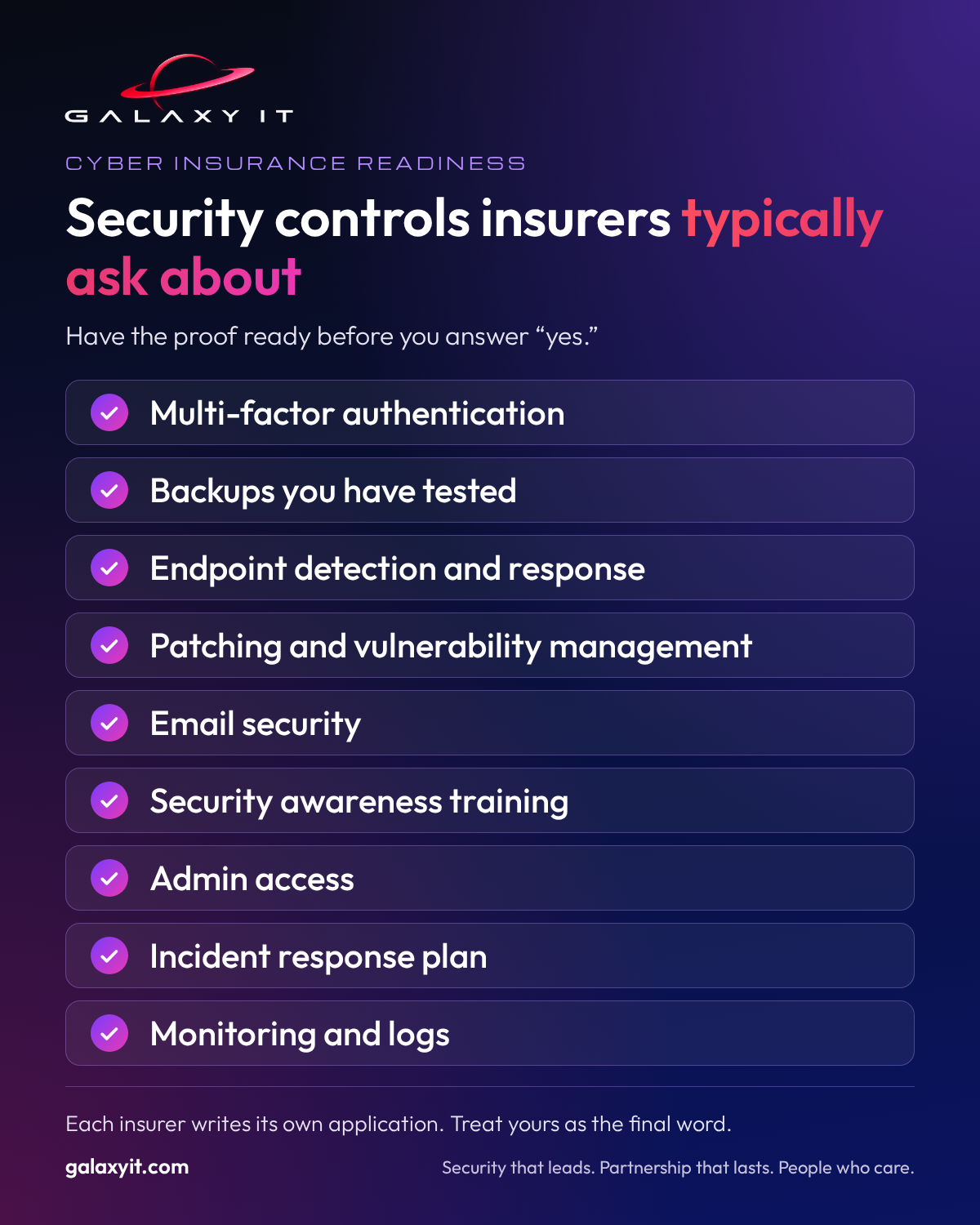
Each of these cyber insurance security controls lines up with federal guidance from the Cybersecurity and Infrastructure Security Agency (CISA) or the National Institute of Standards and Technology (NIST), and each ends with proof that’s worth having on hand before you answer yes. The sample questions come from the Indiana Cybersecurity Hub’s list of typical underwriting questions. Your insurer’s wording will differ.
Multi-factor authentication
MFA asks for a second proof of identity, such as an app prompt or a security key, after the password. Sample questions ask whether you require MFA for web-based email and for administrative or privileged access. CISA’s #StopRansomware Guide recommends “phishing-resistant MFA for all services,” especially email, VPNs and accounts that reach critical systems. NIST’s small business quick-start guide calls MFA “one of the fastest, cheapest ways you can protect your data.” If you’re missing it, CISA’s Cyber Essentials says to start with privileged, administrative and remote access users. Proof to have ready: an MFA report that covers email, admin and remote access accounts, with any exceptions listed.
Backups you have tested
Expect questions about how often you back up, whether MFA protects the backup environment and whether you test backups for restorability. CISA’s guide says to “regularly test the availability and integrity of backups in a disaster recovery scenario.” Know where your copies live and how they’re protected, and describe that exactly on the form. Proof to have ready: the date and result of your last test restore.
Endpoint detection and response
Endpoint detection and response (EDR) watches laptops, desktops and servers for suspicious behavior, not just known viruses. A typical question asks whether you run EDR “on all endpoints.” CISA’s guide recommends allowlisting or EDR “on all assets.” Proof to have ready: a device count from the EDR console that matches your device inventory.
Patching and vulnerability management
Insurers want to know how fast you install security updates and whether you scan for weaknesses. One sample question asks whether critical and high-level patches go in within 30 days of release. Another asks about software that is past its end of life. CISA recommends patching “to the latest available versions,” with internet-facing systems first. Proof to have ready: a recent patch report and a list of any systems that no longer get updates.
Email security
The Indiana list asks whether you tag email from outside senders and whether you filter malicious websites. CISA also recommends a DMARC policy, which lowers the chance that spoofed email appears to come from your domain. Proof to have ready: your domain’s current DMARC record.
Security awareness training
Sample questions ask whether staff get regular training, whether it covers social engineering and whether you run phishing simulations. CISA’s guide says to “repeat security awareness training regularly.” Proof to have ready: completion records and the date of the last phishing simulation.
Admin access
Expect a question on whether you limit access to what each person needs for the job. CISA calls this the principle of least privilege. It warns that attackers often use privileged accounts to spread ransomware across a whole network. Proof to have ready: a current list of admin accounts and who holds each one.
Incident response plan
A written plan names who does what during an attack, including who calls your insurer. The Indiana list asks whether you have a written plan and whether you test your disaster recovery and business continuity plans annually. CISA recommends that you keep the plan current, “regularly exercise” it and keep a hard copy. Proof to have ready: the plan itself and the date it was last exercised.
Utah’s breach notification law (Utah Code 13-44-202) requires a business that owns or licenses computerized data with a Utah resident’s personal information, after becoming aware of a security breach, to investigate promptly and then notify each affected Utah resident if that information has been, or is reasonably likely to be, misused for identity theft or fraud. Notice must be given in the most expedient time possible without unreasonable delay. If the misuse involves 500 or more Utah residents, the business must also notify the Office of the Attorney General and the Utah Cyber Center, and 1,000 or more adds the nationwide consumer reporting agencies. Put those contacts in your plan.
Monitoring and logs
Underwriting questions ask whether you continuously monitor your network and devices, and whether you keep records of that monitoring and review them often. NIST suggests “engaging a service provider to monitor computers and networks” if you can’t do it in-house. CISA recommends keeping logs for critical systems for “a minimum of one year, if possible.” Proof to have ready: a note on who watches the alerts and how long logs are kept.
How do you answer a cyber insurance questionnaire accurately?
Answer for the whole business, as it runs today. The EPA guide notes that insurers use underwriting to assess your organization’s risk, so a “yes” should hold up if someone asks for proof. These habits keep answers honest:
- Read “all” literally. If MFA covers email but not remote access, the honest answer isn’t a plain “yes.” Explain the gap or close it first.
- Gather the proof first. Use the Proof to have ready items above. If you can’t produce the proof, don’t check the box yet.
- Ask your IT provider for the technical answers. Your provider knows how backups are stored, which devices run EDR and how fast patches go in.
- Keep the plan and the policy together. Put your insurer’s claims phone number and your policy number in the incident response plan so nobody has to search for them during an attack.
- Save a copy of what you submitted. Next year’s renewal will ask again, and the answers should still be true.
Bring coverage questions to your agent or broker. Your IT provider can speak to the controls. It can’t tell you what a policy covers.
This post is general information, not legal advice. Galaxy IT is a managed IT and cybersecurity provider, not a law firm or an insurance agency. Talk to your attorney about your legal obligations, and to your insurance agent, broker or carrier about coverage and application requirements. Utah law can change, and other federal or state rules may also apply.
How does Galaxy IT help Utah businesses with cyber insurance questionnaires?
Galaxy IT is a Utah-based managed IT and cybersecurity company serving businesses across all of Utah, including the Wasatch Front. When a client gets stuck on an insurer questionnaire, we help answer it from what’s actually running in that client’s environment.
We help implement a strategy to enable MFA across the board, and we help document where it’s turned on. The controls we manage depend on the services each client chooses with us, so we answer from what’s in place, not from a brochure.
We offer 24/7 monitoring and support, backed by our 100% US-based team. Our backup and disaster recovery service uses immutable backups built to resist ransomware tampering, and we regularly test recovery. Our endpoint security and email security services address two more areas insurers ask about.
Frequently asked questions
Who can help a small business fill out a cyber insurance questionnaire?
Your agent or broker explains the policy, and your IT provider answers the technical questions about MFA, backups, patching and monitoring. If you don’t have an IT provider, a security risk assessment gives you the facts to answer with. Galaxy IT helps Utah clients work through the questions they get stuck on.
Does a small business need cyber insurance?
It depends, and it’s a business decision to make with your agent. NIST’s small business guide lists “assess whether cybersecurity insurance is appropriate for your business” as part of managing cyber risk. The NAIC suggests asking your agent whether you need first-party coverage, third-party coverage or both.
Our malpractice policy doesn’t cover cyber. Does a medical practice need a separate cyber policy?
Ask your agent or broker. A policy covers only what it says, so read the malpractice policy’s exclusions and compare it with a cyber policy before you decide. The security controls in this guide apply either way, and a cyber insurance application is likely to ask about them.
Bring your questionnaire to a free assessment
Start with a free IT assessment, an engineer-led look at your IT and security posture. Bring your insurer’s questionnaire, and we’ll talk through the questions you’re stuck on. To talk first, call (801) 200-5000.
